



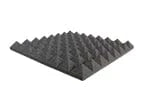

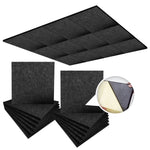
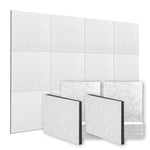

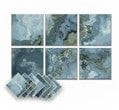
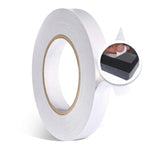


Arrowzoom Pyramid Self-Adhesive Acoustic Foam Tiles — Peel & Stick — Black x Pearl White Bundle - KK1034
Arrowzoom Pyramid Self-Adhesive Acoustic Foam Tiles — Peel & Stick — Black x Pearl White Bundle - KK1034
✅ Peel-and-stick — no glue, no spray, no tape
✅ Lab-tested NRC 0.70, STC 27
✅ 8 colors · 2 sizes — design a wall,
✅ Fire-retardant, non-toxic, built to last

Couldn't load pickup availability
-
Ordered
-
Shipped
- - -
At Your Doorstep

Stick. Press. Quiet room.
Most acoustic foam needs glue, spray adhesive, double-sided tape, or a hardware store trip. The KK1034 doesn't. Each tile ships with a peel-and-stick adhesive backing built in — pull the liner, press to the wall, done. A 12-pack covers a small room in under an hour. Real pyramid acoustic foam, real NRC absorption, no mess.
- Peel-and-stick backing — no glue, no spray, no tape
- NRC 0.74 average · STC 27 — kills echo from voice, music, gaming
- 2″ / 5 cm pyramid foam — same density as studio panels
- 8 solid colors — mix for checkerboard, match for clean
- 100-day returns · if it doesn't quiet your room, send it back
Why KK1034 vs. a $15 Amazon 12-pack
Generic pyramid foam looks similar in a photo. The differences show up the day you install it — and the day you record with it.
| Feature | Arrowzoom KK1034 | Generic Amazon foam |
|---|---|---|
| Adhesive backing | ✓ Built-in peel-and-stick | Glue or tape sold separately |
| NRC + full frequency table | ✓ 0.74 avg, 125 Hz–4 kHz published | “Reduces echo” with no number |
| Fire-retardant rating | ✓ Class B equivalent | Often unrated or uncertified |
| Foam density | ✓ ~30 kg/m³ (studio-grade) | 18–22 kg/m³ (decorative) |
| Color options | ✓ 8 solid colors | 2–3 colors |
| Return policy | ✓ 100-day returns | 14–30 days |
| Track record | ✓ 300,000+ Arrowzoom customers, 150+ reviews on this SKU | Anonymous private label |
The foam shape isn't the differentiator — everyone sells pyramids. The adhesive, the published NRC, the density, and the 100-day guarantee are.
The acoustic numbers (and what they mean)
NRC (Noise Reduction Coefficient) measures how much sound the foam absorbs. Higher = quieter room. Anything above 0.70 is studio-grade.
Read this: NRC drives how a room sounds (echo, harshness, vocal clarity). STC measures how much sound passes through a wall — foam alone won't soundproof a wall, but it kills the echo and reflections that make rooms sound bad on camera, in mics, and on calls.
| Frequency | Transmission Loss | Absorption Coefficient |
|---|---|---|
| 125 Hz | 17 dB | 0.11 |
| 250 Hz | 17 dB | 0.24 |
| 500 Hz | 22 dB | 0.64 |
| 1,000 Hz | 27 dB | 1.06 |
| 2,000 Hz | 32 dB | 1.03 |
| 4,000 Hz | 36 dB | 1.10 |
| Overall STC | 27 | |
Who buys this
What's in the box
- Pyramid acoustic foam tiles with peel-and-stick adhesive backing
- Choose your size: 10″ × 10″ × 2″ (25 × 25 × 5 cm) or 20″ × 20″ × 2″ (50 × 50 × 5 cm)
- Pack sizes: 1, 12, or 24 tiles
- Tile weight: ~0.18 lb / 80 g (small) · ~0.66 lb / 300 g (large)
Available colors
Coverage cheat sheet
- Mic booth wall (4 ft × 4 ft · 1.2 m × 1.2 m): 12 large tiles or 24 small
- Small home office (10 × 10 ft · 3 × 3 m): 24–36 tiles for key reflection points
- Full room treatment (12 × 12 ft · 3.6 × 3.6 m): 48–72 tiles across walls + ceiling corners
Install in 4 steps
- Unbox and let the foam expand 24–48 hours (it ships vacuum-sealed).
- Wipe the wall clean — dust and grease are the #1 reason adhesive fails.
- Peel the liner off the back of the tile.
- Press firmly to the wall for 30 seconds. Repeat. Done.
Pro tip: for painted drywall older than 5 years or textured walls, add a strip of mounting putty in each corner. The factory adhesive holds on smooth, clean surfaces — not on dust, eggshell finish, or bare brick.
Technical specifications
| Material | High-density polyurethane acoustic foam, pyramid profile |
| Thickness | 2″ / 5 cm |
| Tile sizes | 10″ × 10″ (25 × 25 cm) | 20″ × 20″ (50 × 50 cm) |
| Tile weight | ~0.18 lb / 80 g (small) · ~0.66 lb / 300 g (large) |
| NRC (avg) | 0.74 (peak 1.10 at 4 kHz) |
| STC | 27 (overall) |
| Backing | Self-adhesive (peel-and-stick) — standard non-adhesive version also available |
| Fire rating | Fire-retardant (Class B equivalent) |
| Density | ~30 kg/m³ / ~1.87 lb/ft³ |
| Colors | 8 (Black, Pearl White, Gray, Red, Burgundy, Blue, Baby Blue, Yellow) |
| Handling time | 1–2 business days |
| Shipping | Standard 7–14 days · Express ≤7 days · free worldwide on orders over $99 |
Stick them up, listen to your room, run a recording test. If it doesn't cut the echo and tighten your audio, send them back inside 100 days for a full refund. Backed by 300,000+ Arrowzoom customers and 150+ verified reviews on this product.
Frequently asked
Click any question to expand ↓
Will this soundproof my wall so my neighbors can't hear me?
No — and don't trust anyone who promises that with foam alone. Acoustic foam absorbs sound inside the room (NRC 0.74 here, which is studio-grade). To block sound through a wall you need mass — mass-loaded vinyl, double drywall, or a Green Glue assembly. Use this foam to make your room sound better on mics and calls. Use mass to stop sound passing through.
What does NRC 0.74 actually mean?
NRC = Noise Reduction Coefficient, a 0–1 scale of how much sound a material absorbs. 0.74 means roughly 74% of mid-band sound is absorbed instead of bouncing back. Anything above 0.70 is considered studio-grade. Most painted drywall scores around 0.05.
What's STC 27 and does it matter for me?
STC (Sound Transmission Class) measures how much sound a material blocks from passing through a wall. STC 27 is what we measured on this foam alone — it's a useful number for spec sheets, but foam is bought for absorption (NRC), not transmission loss. If your goal is to stop sound passing through a wall, you need mass plus the foam, not the foam alone.
Will the adhesive damage my wall when I take it off?
On smooth, painted drywall in good condition: usually no — the adhesive peels off cleanly with slow, steady pressure. On older paint, eggshell, wallpaper, or freshly painted walls (under 30 days): it may pull off paint or adhesive residue. If you're renting and worried, use mounting putty or removable Command strips on the back of each tile instead of the factory adhesive.
How many tiles do I actually need?
You don't need to cover every wall. For a podcast/streaming setup, 12–24 tiles around the mic position is usually enough. For a home office, 24–36 tiles on the wall behind you and the wall facing your mic. For a full music room, 48+ tiles spread across walls and ceiling corners. Want exact numbers? Use our Tiles Calculator — punch in your room and tile size and it tells you how many to order (with a 5–10% buffer for cuts and mistakes).
Why does the foam look squashed when it arrives?
It ships vacuum-sealed to cut shipping cost and carbon. Unbox the tiles and let them sit 24–48 hours — they expand back to full 2″ / 5 cm thickness on their own. Don't install while compressed; the adhesive bonds best at full thickness.
Is the foam fire-safe?
Yes — it's treated to be fire-retardant (Class B equivalent in most regions). It resists ignition and self-extinguishes once a flame source is removed. It is not fireproof — no foam is — so don't install it next to open flame, halogen bulbs, or unvented heaters.
Will it work on textured walls or brick?
Peel-and-stick adhesive works best on smooth, clean, painted drywall. On textured paint, popcorn ceilings, brick, or stone, the contact area is too small for the adhesive to grip. Use construction adhesive or polyurethane spray adhesive instead — or pick our non-adhesive version and mount with spray adhesive.
What size and pack should I order?
10″ tiles (25 cm) are easier to lay out in patterns and around outlets / vents. 20″ tiles (50 cm) cover ground faster — one large tile = four small. Order the 12-pack for a single mic wall, the 24-pack for a small room, two 24-packs for a full room. Mix colors for a checkerboard look.
Can I use it on the ceiling?
Yes, but use a backup. The factory adhesive holds on smooth ceilings short-term, but ceilings collect dust and gravity isn't on your side. For permanent ceiling install, add a few dabs of construction adhesive on the back of each tile, or use foam-safe spray adhesive. Hang during cooler hours — warm ceiling drywall reduces grip.
How long until it arrives in the US?
Handling time is 1–2 business days before the package leaves our warehouse. Standard shipping to the US and most countries lands in 7–14 days. Express shipping arrives in 7 days or less. Free worldwide shipping on orders over $99. No surprise import duties on US delivery — the price you see is the price you pay.
What's the return policy?
100-day returns from the day you receive it. If the foam doesn't solve your echo / room-sound problem, send it back for a refund. Tiles must be in resaleable condition (don't glue them up if you might return them — do a small listening test first).
Shipping & Returns
Shipping & Returns
Purchase over $99USD or more to get FREE Shipping.
Normal Shipping
- 1-2 weeks in your hands
Express Shipping
- 1 week or less in your hands
Returns Policy
- We accept returns under specific conditions. Please follow these guidelines:
- How to Initiate a Return: Email service@arrowzoom.com with your name and order number.
- No Refunds for Buyer’s Remorse: Ensure your order details (design, size, address) are correct before purchasing.
- Cancellation Fee: Orders canceled (shipped or not) incur a 15% fee due to production costs.
Returned Parcels:
- Reshipping requires you to pay the shipping fee.
- For wrong items or quality issues, we refund the product value minus a 50% restocking fee.
- Shipping costs are non-refundable.
Return Conditions:
- Items must be in new, unaltered condition.
- Returns for mistaken shipments must be approved within 3 working days of receipt.
- Requests must be made within 2 weeks of shipping.
Note: No credit is given for items damaged during shipping. Contact the shipping company for compensation.


Soundproofing FAQs
Frequently Asked Questions
How do I soundproof my wall against noisy neighbours? 🤫
How do I soundproof my wall against noisy neighbours? 🤫
Soundproofing aims to prevent sound from entering or leaving a room, like blocking noise from those pesky neighbours. For more tips, check out our guide on soundproofing against noisy neighbours! 📖
How many Acoustic Panels Do I Need?
How many Acoustic Panels Do I Need?
The first step is going to be installing acoustic panels on your walls. These reduce the reverberations and echoes in the space.
Use our Free Tiles Calculator to find out
How do you install soundproofing? 🔧
How do you install soundproofing? 🔧
There are two main options for installing our DIY soundproofing solutions, and we're here to support you every step of the way!
DIY Installation:
All of our systems are DIY-friendly, saving you on installation costs.
80% of customers install the systems themselves because we’ve made it easy!
We provide simple, step-by-step installation guides and videos for a hassle-free experience.
Our technical team is ready to answer any questions and offer support. We're here for you! 🤗
Use a Local Contractor:
You're on your way to a noise-free home! If DIY isn’t an option, consider hiring a local tradesperson.
We simplify the process by communicating directly with your tradesperson throughout the installation.
Visit our installation page for more details! 📞
What's the difference between impact and airborne noise? 🔊
What's the difference between impact and airborne noise? 🔊
1. Airborne Noise
- This travels through the air, like conversations, TV sounds, or barking dogs. When sound waves hit a building, they cause it to vibrate, transmitting through the structure.
2. Impact Noise
- This results from physical impacts on buildings, such as footsteps, slamming doors, or moving furniture. Impact noise can be harder to isolate, as these vibrations are stronger and travel further through dense materials.
What are decibels? 📏
What are decibels? 📏
Decibels are measured logarithmically (not as a percentage) . This means that every increase of 10dB on the scale is a tenfold increase in sound pressure level (SPL) . Near silence is 0dB 🤫, while a sound at 10dB is ten times louder!
- 30-40 dB = Soft music, whisper 🎶
- 60-80 dB = Office noise, traffic 🚗
- 85-100 dB (HARMFUL) = Subway, shouted convo, chainsaw ⚠️
- 100-140 dB (DANGEROUS) = Chainsaw, loud concert, racing, shooting range 🚨
Is everything in stock and ready to ship? 📦
Is everything in stock and ready to ship? 📦
In stock, ships in 1-2 business days! Learn More
Where Is My Order?
Where Is My Order?
Track your order: Check your email or visit our Tracking Page.
FREE & FAST GLOBAL SHIPPING 🚚
30 DAYS RETURNS ✅
24/7 Live Support 📞
FREE & FAST GLOBAL SHIPPING 🚚
30 DAYS RETURNS ✅
24/7 Live Support 📞
FREE & FAST GLOBAL SHIPPING 🚚
30 DAYS RETURNS ✅
24/7 Live Support 📞
FREE & FAST GLOBAL SHIPPING 🚚
30 DAYS RETURNS ✅
24/7 Live Support 📞
FREE & FAST GLOBAL SHIPPING 🚚
30 DAYS RETURNS ✅
24/7 Live Support 📞
FREE & FAST GLOBAL SHIPPING 🚚
30 DAYS RETURNS ✅
24/7 Live Support 📞
FREE & FAST GLOBAL SHIPPING 🚚
30 DAYS RETURNS ✅
24/7 Live Support 📞
FREE & FAST GLOBAL SHIPPING 🚚
30 DAYS RETURNS ✅
24/7 Live Support 📞
FREE & FAST GLOBAL SHIPPING 🚚
30 DAYS RETURNS ✅
24/7 Live Support 📞
FREE & FAST GLOBAL SHIPPING 🚚
30 DAYS RETURNS ✅
24/7 Live Support 📞
FREE & FAST GLOBAL SHIPPING 🚚
30 DAYS RETURNS ✅
24/7 Live Support 📞
FREE & FAST GLOBAL SHIPPING 🚚
30 DAYS RETURNS ✅
24/7 Live Support 📞
